On this page
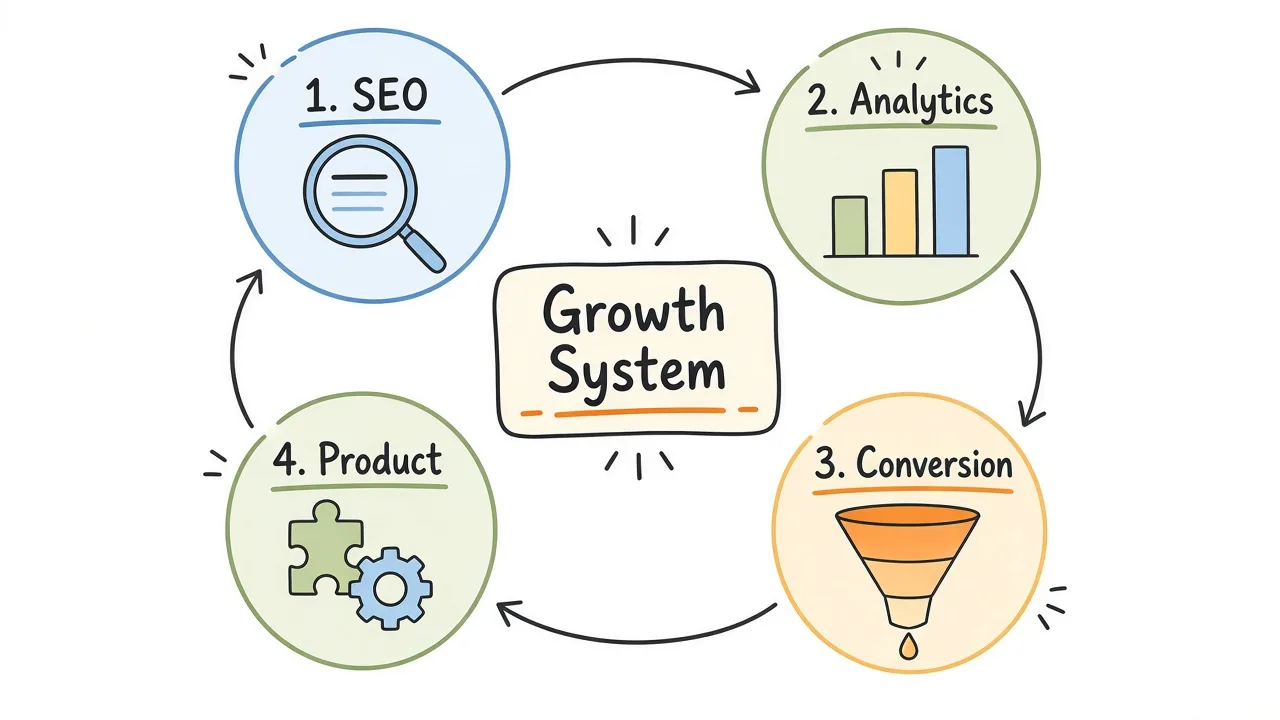
Most SaaS product sites grow by publishing more. More blog posts, more landing pages, more webinars, more paid campaigns that send people to a homepage that still talks in feature lists. Traffic moves. Pipeline does not. The missing piece is usually a connected system: search and content bring the right people in, analytics show where they stall, conversion paths match the job they came to do, and product-led loops turn early product use into the next visit or invite.
This guide lays out a growth marketing strategy for SaaS product sites that ties those four loops together, from ICP and site information architecture through experiment cadence, paid channels, common mistakes, and when to DIY versus hire help.
Treat the product site as one connected system
Growth marketing for a SaaS site is the work of making acquisition, measurement, conversion, and product feedback reinforce each other. SEO without conversion clarity fills the top of the funnel with people who bounce. Conversion work without analytics is opinion. Analytics without product signals tells you who clicked and not who got value. Product-led loops without a coherent site leave invites and docs pointing at pages that contradict the in-app story.
Think of four linked loops rather than four departments.
- SEO and content answer jobs people already search for, on pages you can own and update.
- Analytics answer decision questions with events that match those jobs. Pageviews alone rarely decide what to ship next.
- Conversion routes visitors into the right next step for their stage (trial, demo, docs, pricing).
- Product-led loops surface activation and retention signals back onto the site (success stories tied to real use, invite CTAs, changelog, templates) so marketing and product share language.
When one loop is missing, teams usually compensate with volume. Volume is expensive and slow to diagnose. Connection is cheaper to instrument and faster to learn from.
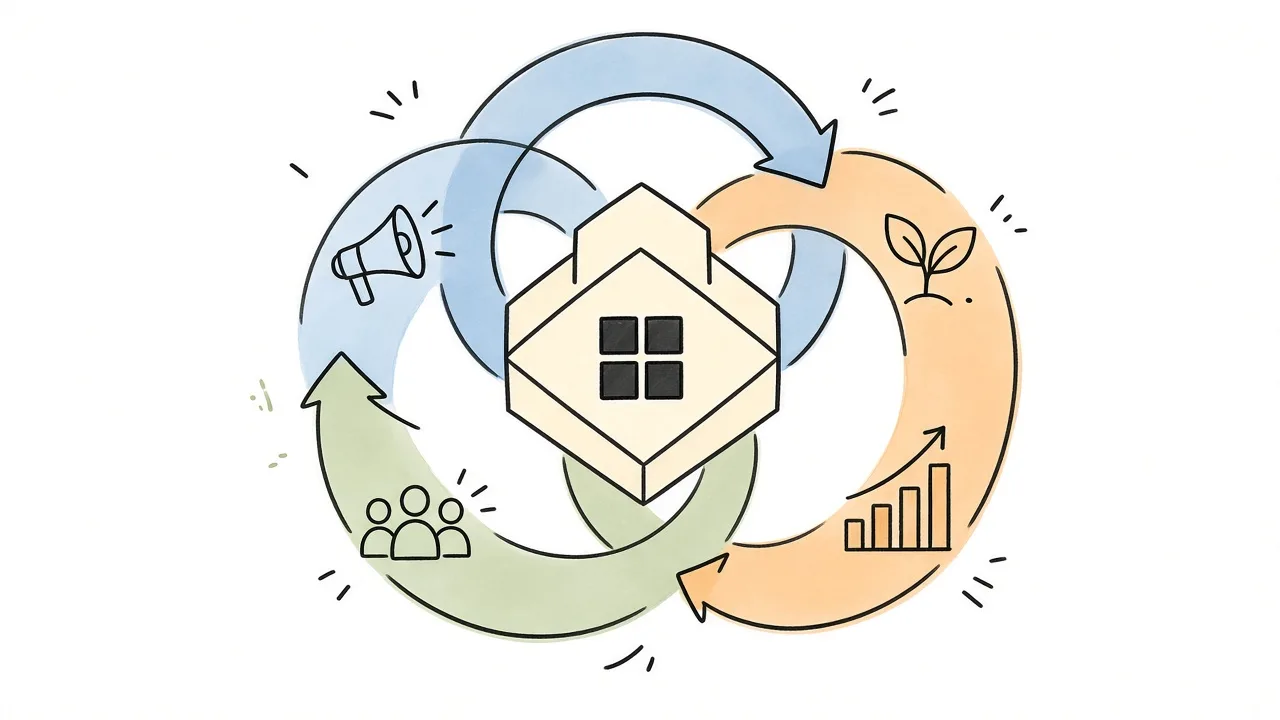
Four loops around a product site: search and content, measurement, conversion paths, and product-led signals feeding back into the marketing site.
Start with ICP and jobs-to-be-done, then write the site
Ideal customer profile (ICP) work is often a slide. For growth on a product site, it has to become page jobs.
Write three short artifacts before you redesign IA or open a content calendar.
- Who buys and who uses. Name the buyer role, the daily user role, and whether they are the same person. A founder-led PLG tool and an enterprise workflow with a security review are different sites even if the product logo matches.
- Jobs-to-be-done on the site. List the jobs a visitor is trying to finish on this domain: evaluate fit, compare pricing, understand security, start a trial, invite a teammate, find a template, renew trust after churn. Jobs-to-be-done research (the outcome the customer hires your product for) still matters. On a growth site you also need the site jobs that sit between awareness and product value.
- Disqualifiers. Say who you will not optimize for. If you cannot serve agencies at five seats, do not write content that attracts them and then blame conversion.
Map each major URL to one primary job and one primary CTA. If a page tries to sell, educate, and onboard at once, analytics will look noisy because the page is noisy.
Best practice: Put the ICP and site-job list in the same doc as your event taxonomy. When product renames a plan or changes onboarding, update both together so marketing pages and product analytics stay aligned.
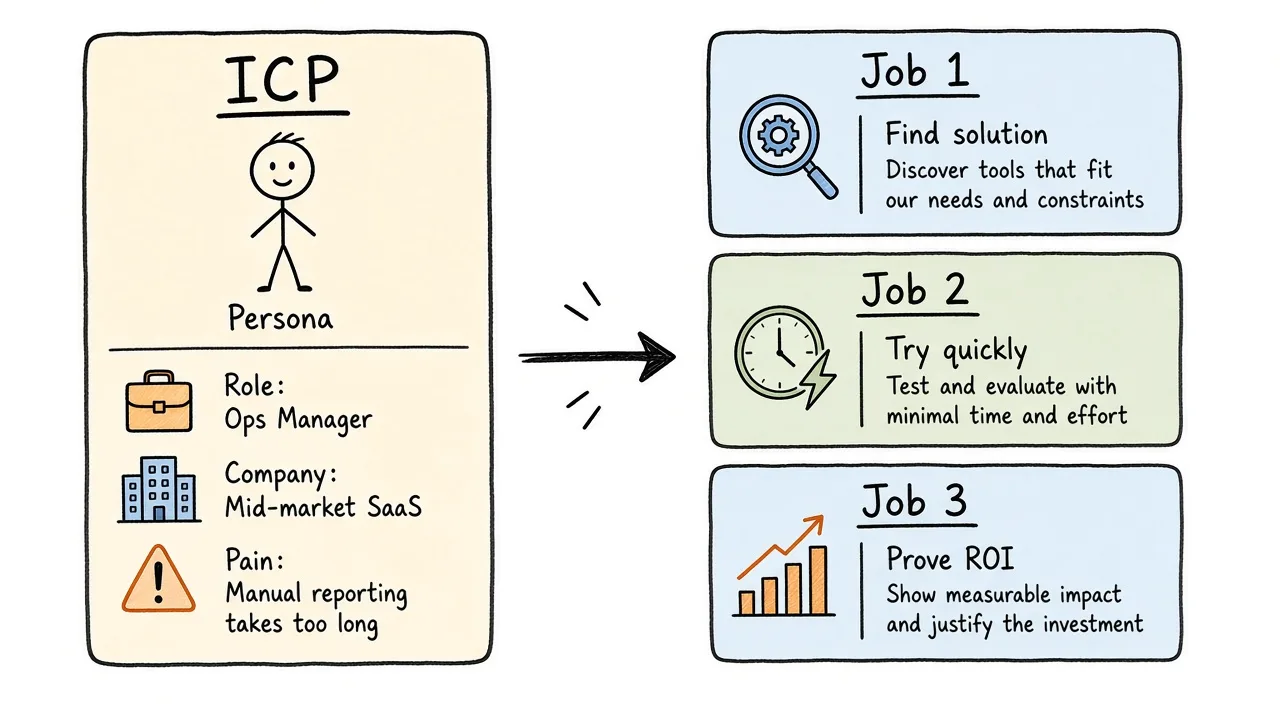
Buyer and user roles on one side, site jobs and destination pages on the other, so each URL owns one primary job.
Design site information architecture around the product
A SaaS marketing site usually needs a small set of durable hubs.
| Hub | Job on the site | Typical primary CTA |
|---|---|---|
| Home | Orient the right ICP in seconds | Trial or demo |
| Product / features | Prove capability for named jobs | Trial, demo, or deep docs |
| Pricing | Reduce uncertainty on cost and packing | Trial or sales |
| Customers / proof | Transfer trust from peers | Trial or demo |
| Docs / resources | Help evaluation and activation | Sign-in, install, or specific guide |
| Blog / learn | Capture demand and explain category | Soft CTA into hubs above |
| Company / trust | Handle security, legal, and about | Contact or trust center |
Internal links should push people toward money and activation hubs. A blog that only circulates readers among posts wastes the visit. Orphans that only appear in a sitemap are a smell. So are three near-identical “feature” pages that compete for the same query and the same CTA.
Navigation labels should match how buyers talk. If your ICP says “integrations,” do not bury that under “platform.” If security review is a gate for half of deals, give security its own reachable path instead of a PDF hidden in a footer.
For crawl and index fundamentals that keep these hubs discoverable, a focused technical SEO audit still belongs in the stack. Growth strategy assumes bots can reach the pages you care about.
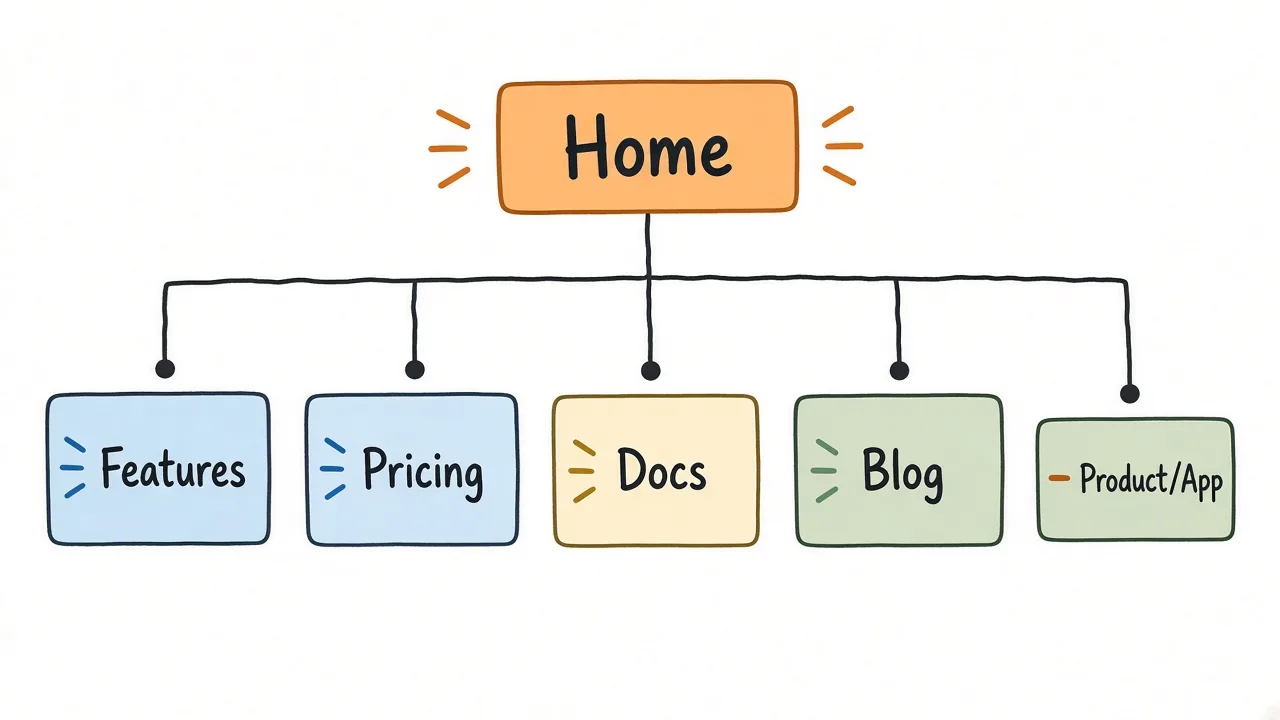
Durable hubs for a SaaS marketing site, with internal paths pointing at trial, demo, and docs rather than endless blog loops.
Build content for acquisition jobs ahead of publishing volume
Content volume vanity looks productive in a calendar. It fails when posts do not map to ICP jobs, do not link into product hubs, and do not change how you measure success.
Prioritize topics with a simple filter.
- Does a real ICP search this? Category and problem queries beat keyword lists scraped from competitors.
- Can we earn the click with experience? Prefer angles where you have product truth, customer language, or operator detail. Google’s people-first content guidance is a useful bar here: would someone bookmark this if they arrived from a colleague?
- Is there a next step on our site? Every post should have an honest path into a hub (pricing, integration page, template, docs, comparison that you can defend).
- Will we maintain it? Stale comparison and “best tools” pages actively hurt trust.
Formats that usually earn their keep on SaaS product sites include problem explainers tied to your ICP, integration and workflow pages, honest comparisons you can update, customer stories with concrete setup context, and docs-adjacent guides that reduce time-to-value. Formats that often waste budget include generic thought leadership with no product path, keyword-stuffed listicles, and AI-generated doorway pages that restate the SERP.
Measure content on assisted trials or demos, qualified engagement on money hubs, and retention of rankings on pages you chose on purpose. Publishing cadence is a capacity decision that follows those signals.
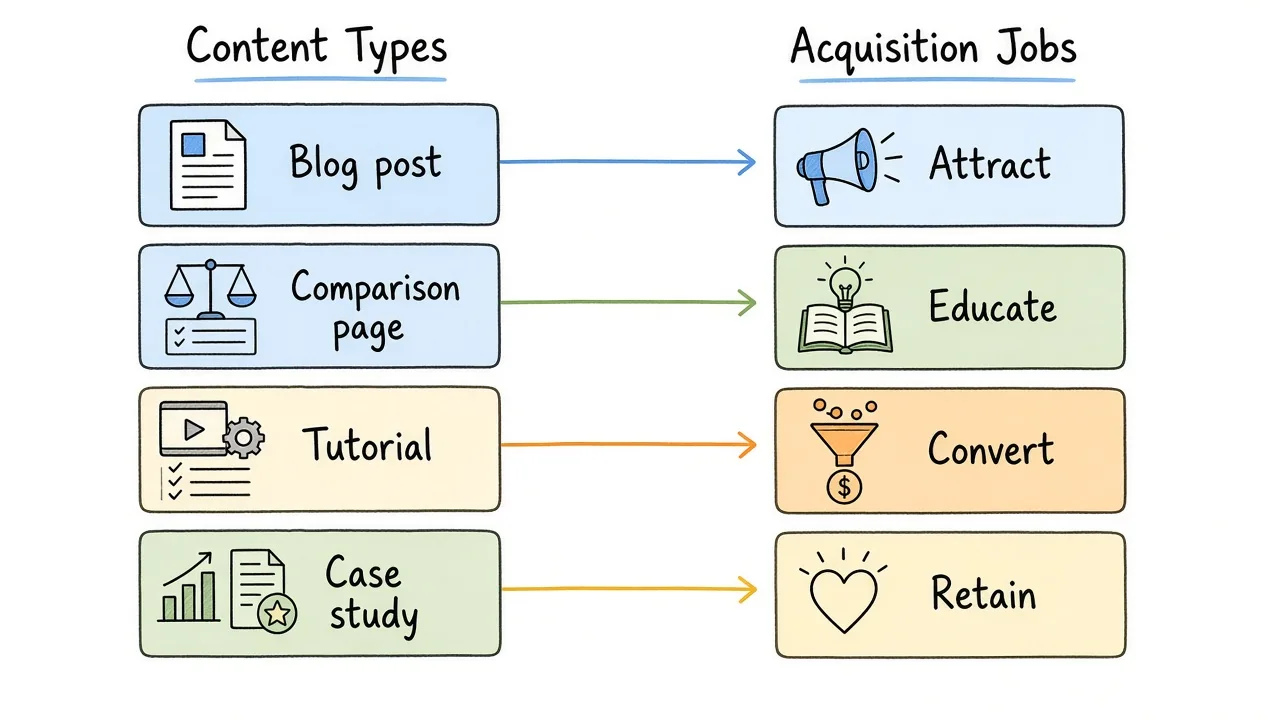
A content brief filter that asks for intent, product truth, a path into product hubs, and an owner who will maintain the page.
Instrument analytics that answer decisions
Analytics on a SaaS marketing site should answer questions you will actually act on.
Useful decision questions look like this.
- Which entry pages produce trial starts from the ICP we named?
- Where do pricing visitors exit before signup?
- Do docs sessions precede activation in the product, or only bounce?
- Which campaigns and organic clusters assist pipeline versus one-session noise?
To answer them, define a thin event set that matches site jobs: view_pricing, start_trial, request_demo, open_docs_path, invite_teammate (if that CTA lives on the marketing site), and key content engagement that you treat as a leading signal. Keep names stable. Map the same events into product analytics where possible so marketing and product can argue from one funnel language.
Use Google Analytics or your preferred stack with clear property ownership, a documented UTM convention, and Search Console connected for organic diagnosis. Dashboards that only show sessions and bounce rate will push the team toward more traffic. Dashboards that show trial quality by landing page and channel push the team toward better pages.
Warning: Do not invent a “growth score” from five vanity metrics. If leadership needs one number, pick a north-star that already sits in the business (activated accounts, qualified demos) and show leading page metrics underneath it.
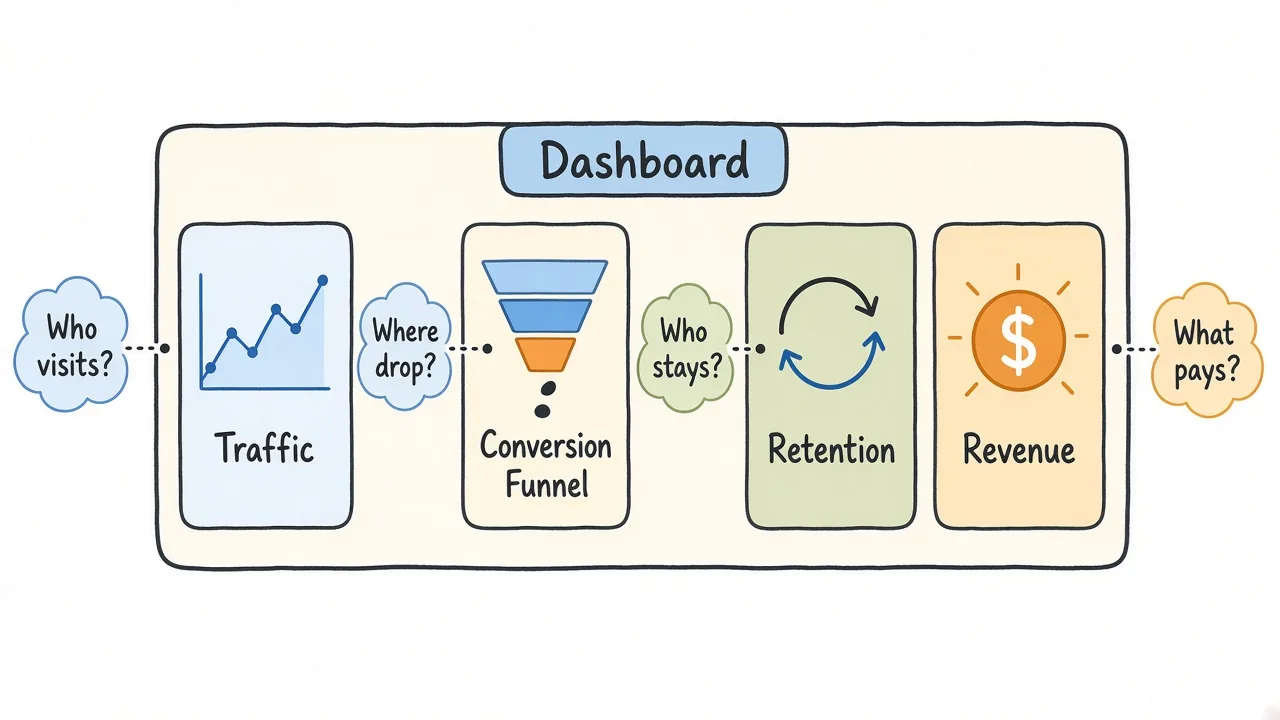
Decision questions on the left, a short event list on the right, so reporting stays tied to actions you can change on the site.
Design conversion paths that match stage and ICP
Conversion is the design of the next step. A single homepage button rarely covers every stage.
Segment paths by stage.
- Early research. Soft proof, category clarity, and a low-friction path into a relevant guide or product overview.
- Active evaluation. Pricing clarity, security and compliance paths, comparison honesty, and a trial or demo CTA that matches sales motion.
- Ready to start. Fast path to signup with minimal form friction for PLG, or a calendar path for sales-led motions.
- Existing users arriving from search. Route them to docs, login, or account areas instead of a cold homepage pitch.
Match CTA to ICP. A security buyer who lands on an integration page may need “Talk to us about SSO” more than “Start free.” A solo builder may need “Start free” more than “Book a demo.” One CTA for every visitor is how you train people to ignore the button.
Reduce friction with progressive disclosure. Show plan differences on pricing without forcing a sales call for a self-serve SKU. Keep legal and security links visible for enterprise evaluation. Load speed and form reliability are conversion work; a slow marketing site teaches buyers that the product will feel heavy.
A/B tests belong after the path is coherent. Testing button color on a confused pricing page teaches you which confusing variant loses less.
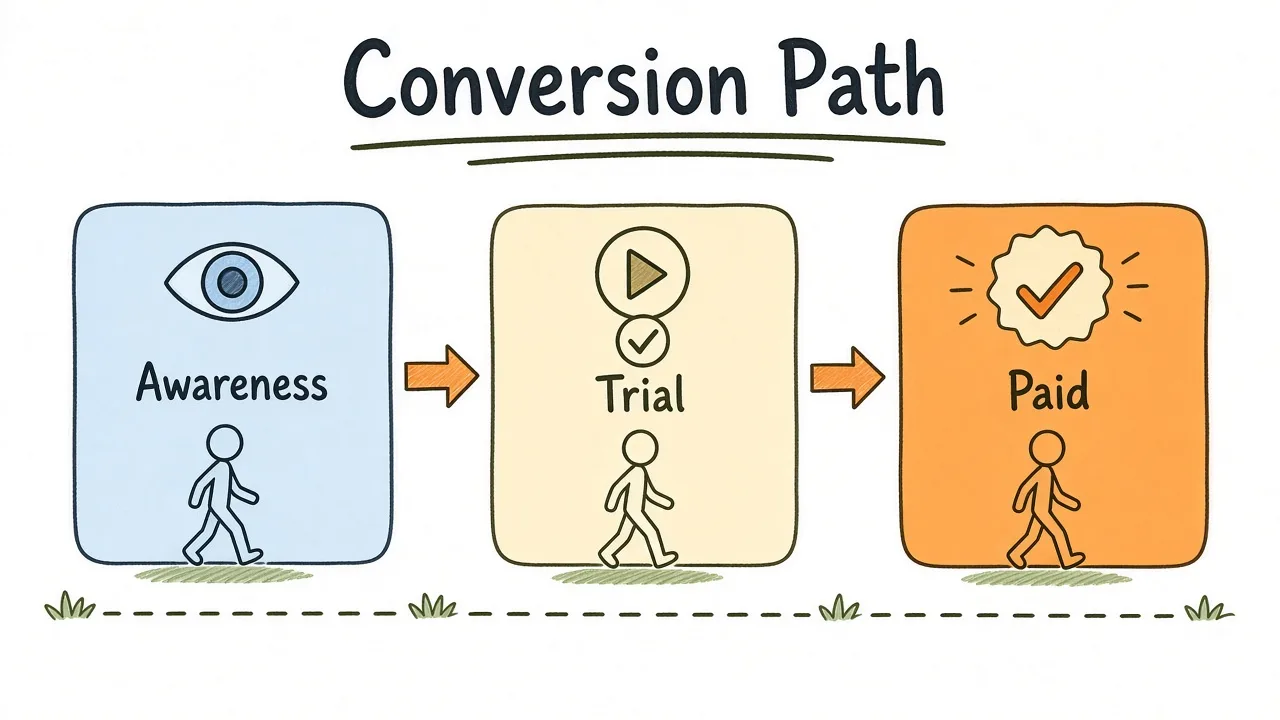
Stage-based paths from research through evaluation and signup, with returning users routed toward docs and login.
Close product-led loops on the marketing site
Product-led growth is often discussed as in-app viral mechanics. The marketing site still has a job in those loops.
Surface activation and retention signals where buyers and users already look.
- Activation cues. Show the first value moment in screenshots and copy (the setup that usually unlocks the “aha”), and link to the exact docs or templates that get someone there.
- Invite and share surfaces. If invites matter, give them a clear story on the site (why invite, what the teammate sees) instead of only an in-app modal.
- Changelog and roadmap honesty. Public change logs reduce support load and give returning visitors a reason to come back without inventing newsletters that say nothing.
- Customer proof tied to use. Stories that name role, setup, and outcome transfer better than logo walls alone.
- Cross-links from product to marketing. Empty states and upgrade screens should open owned pages that match the in-app claim, so you can measure and improve those pages.
Retention shows up on-site when people return for docs, templates, status, and community. Treat those properties as growth surfaces with owners and events.
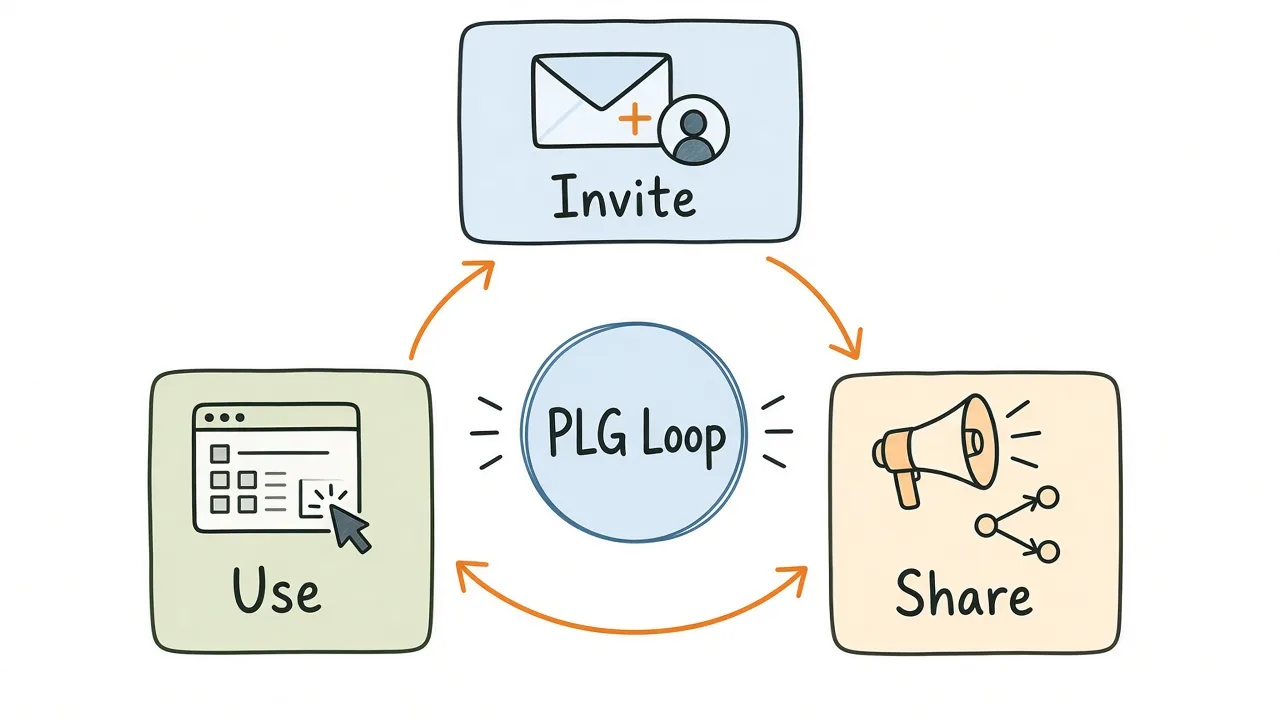
In-app value feeding invites and docs, with changelog and proof pages on the marketing site completing the loop.
Run an experiment cadence you can staff
Growth without a cadence becomes a pile of opinions. A workable cadence for a small SaaS team is weekly learning and monthly portfolio decisions.
Weekly. Review the decision dashboard. Pick one hypothesis tied to a page or path (for example, “pricing visitors from organic need plan comparison above the fold before trial”). Ship the smallest change that tests it. Record result in a shared log with date, audience, change, metric, and decision.
Monthly. Re-rank the backlog by expected impact and confidence. Kill experiments that cannot get instrumentation. Promote winning patterns into the default templates. Update content priorities from Search Console and CRM reality before you lean on keyword tools alone.
Quarterly. Revisit ICP and site jobs. Product packaging changes invalidate old pricing and comparison pages. Put that refresh on the calendar so it stops arriving as a surprise.
Cap concurrent tests so analytics stay readable. One strong experiment finishes faster than five overlapping ones that share traffic and confuse attribution.
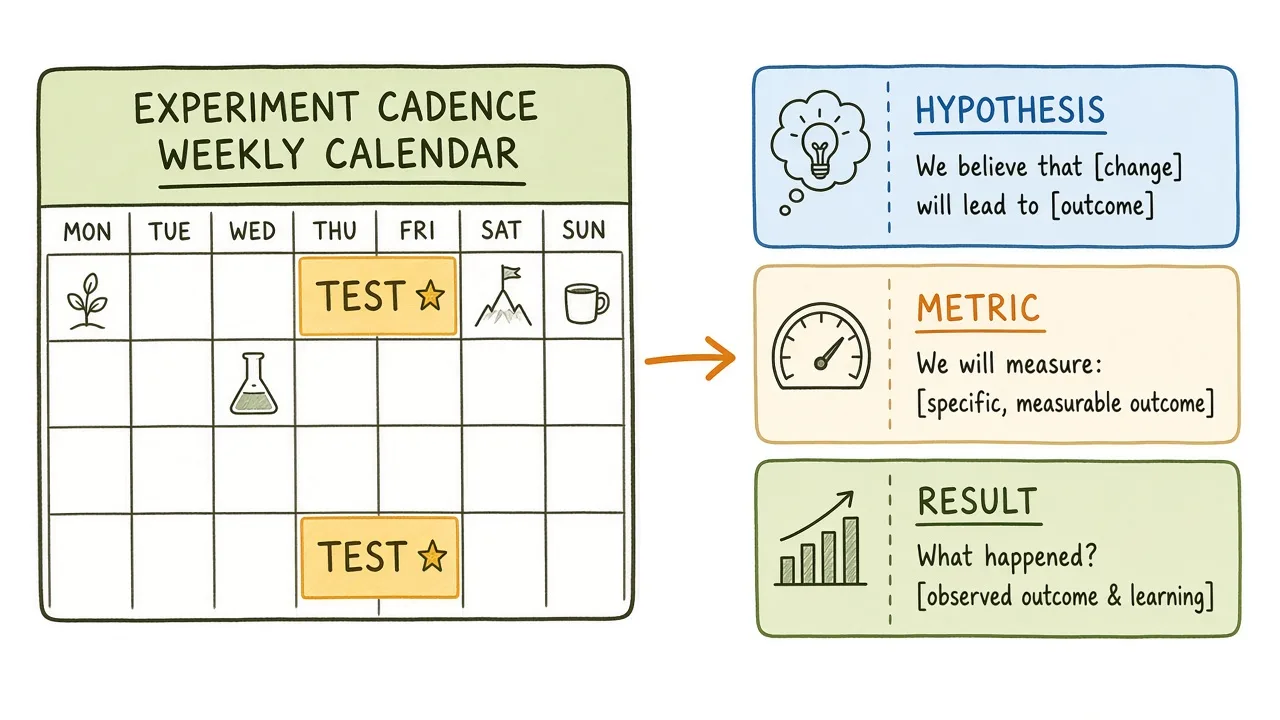
A simple operating rhythm with weekly tests, monthly backlog ranking, and quarterly ICP and packaging checks.
When paid acquisition helps (and when it burns cash)
Paid search, social, and sponsorships help when the site already converts the ICP you are buying, events are trustworthy, and creative points at a specific job page. Paid then buys learning speed and volume on proven paths.
Paid hurts when you use it to paper over a vague homepage, when landing pages disagree with ad promises, when you optimize for cheap clicks from the wrong ICP, or when attribution is so broken that every channel claims the same trial.
A practical rule. Fix the organic and on-site path for one ICP job until you can explain why people convert. Then scale paid into that path with matching landing pages and the same events. Retargeting works better when the site gave the visitor a clear unfinished job (pricing, docs chapter, partially completed signup) rather than a generic brand impression.
If you are still arguing about whether the product message is clear, spend on product marketing clarity before you scale media.
Common SaaS product site mistakes
These show up repeatedly on commercial investigation calls.
- Blog as the product. The homepage and pricing stay stale while the content team ships posts nobody routes into hubs.
- One CTA for every visitor. Demo-only or trial-only buttons ignore stage and role differences.
- Feature tours without jobs. Visitors leave knowing what buttons exist and not whether the product finishes their work.
- Analytics theater. Dozen of tags, no documented event meanings, and dashboards nobody uses in decisions.
- Orphan docs and trust pages. Security, status, and API docs live on subdomains with no path from evaluation pages.
- Comparison pages you will not maintain. Outdated claims become a trust tax.
- Paid before path. Ad spend lands on a homepage that still speaks in internal roadmap language.
- No owner for the connected system. SEO, demand gen, PMM, and product each optimize locally and the site never coheres.
Common mistake: Treating “more content” as the default fix for flat pipeline. Flat pipeline on a SaaS site is often a conversion or ICP mismatch problem wearing an SEO costume.
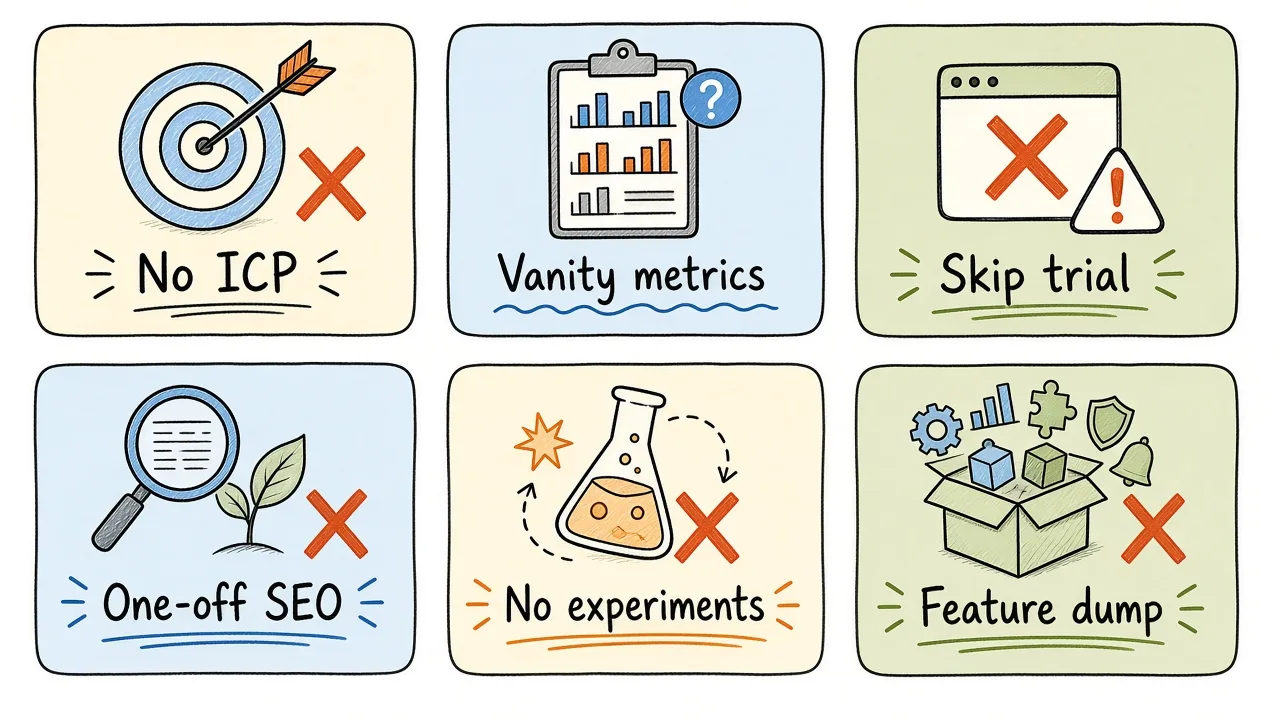
Frequent failure modes around a product site: blog isolation, single CTA, analytics theater, orphan trust pages, and paid before path.
Worked scenario: a mid-market B2B SaaS with flat trials
Imagine a B2B workflow product selling mostly self-serve trials with a sales assist for larger seats. Organic sessions are healthy. Trial starts are flat. The team wants a bigger content budget.
Investigation order.
- ICP check. Sales notes show the best-retained accounts are operations leads at 50-500 person companies. The blog ranks for agency freelancers who churn fast.
- IA and paths. Pricing hides seat limits. Security lives in a PDF. Integration pages exist but are not linked from the top navigation.
- Analytics. Trial start fires, but there is no event for “viewed security” or “opened integration X,” so nobody can see what evaluators actually do.
- Conversion. Homepage CTA is only “Book a demo,” which freelancers ignore and ops leads distrust when they wanted a trial.
- Product loop. Docs explain setup well, but marketing never links the top three activation guides from product pages.
First sprint (illustrative sequence only; outcomes depend on your product and market).
- Rewrite homepage and pricing for the ops ICP, with trial as primary and demo as secondary for high-seat paths.
- Add navigation and internal links to integrations and a trust/security page built from the PDF.
- Instrument view_security, view_integration, and start_trial with source page dimensions.
- Pause content topics aimed at freelancers. Rebrief two posts to ops jobs with links into pricing and the relevant integration.
- Put the three activation docs on the product overview and in the trial welcome email.
You learn whether trials move before you fund a larger editorial machine. If trials still stall after path clarity, the problem may be product activation or packaging, which marketing volume will not fix.
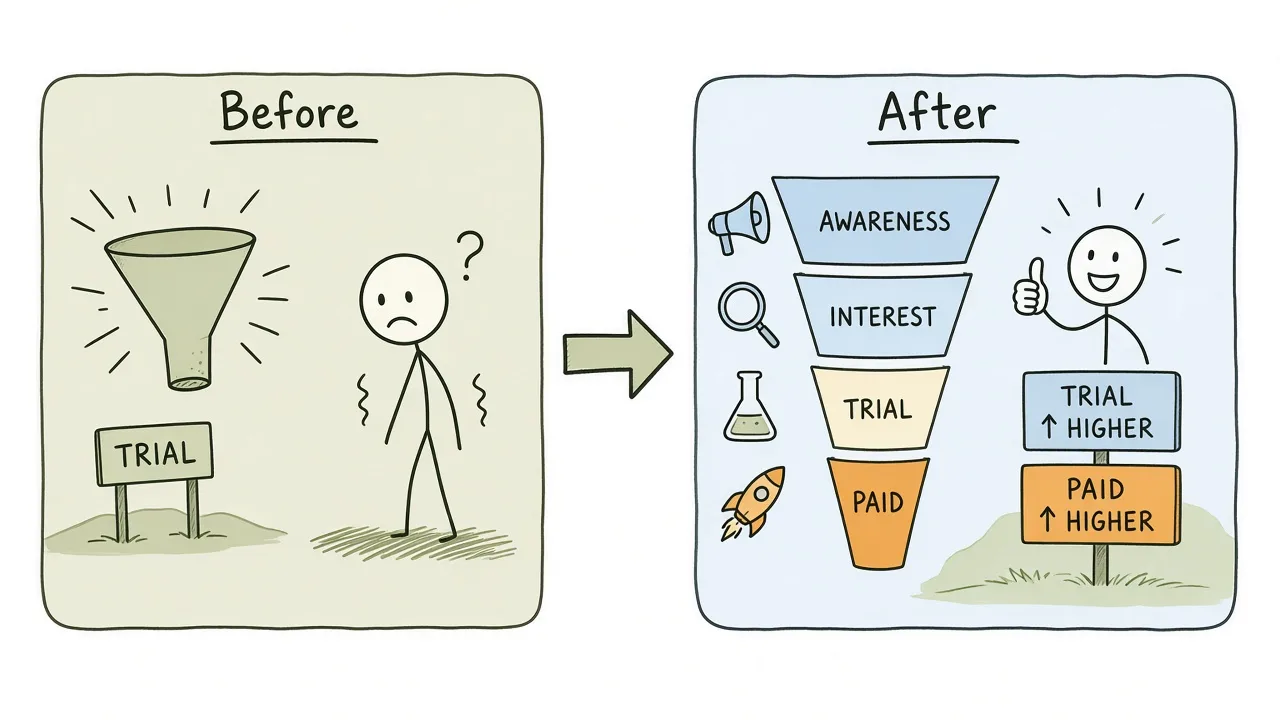
Investigation flow for flat trials: confirm ICP, fix paths and events, then run a focused sprint before expanding content volume.
DIY versus hire growth help
DIY works when you have a clear ICP, access to analytics and Search Console, a developer who can ship landing and event changes, and a founder or PMM who can own the weekly review. Start with the connected-system map, thin events, and hub IA. Ship content only against that map.
Hire help when channels disagree on what “worked,” the site has accumulated years of conflicting landing pages, you need a partner to connect SEO, conversion, and measurement without adding a bloated stack, or the team is stuck in volume mode and needs an outside operator to reset priorities. A good engagement leaves you with owners, a backlog, and instrumentation you can run without the consultant living in your Slack forever.
Decline or reshape engagements that promise ranking guarantees, unlimited posts with no ICP filter, or dashboards with no decision cadence. For scope that ties acquisition to pages and flows you can change, see growth marketing.
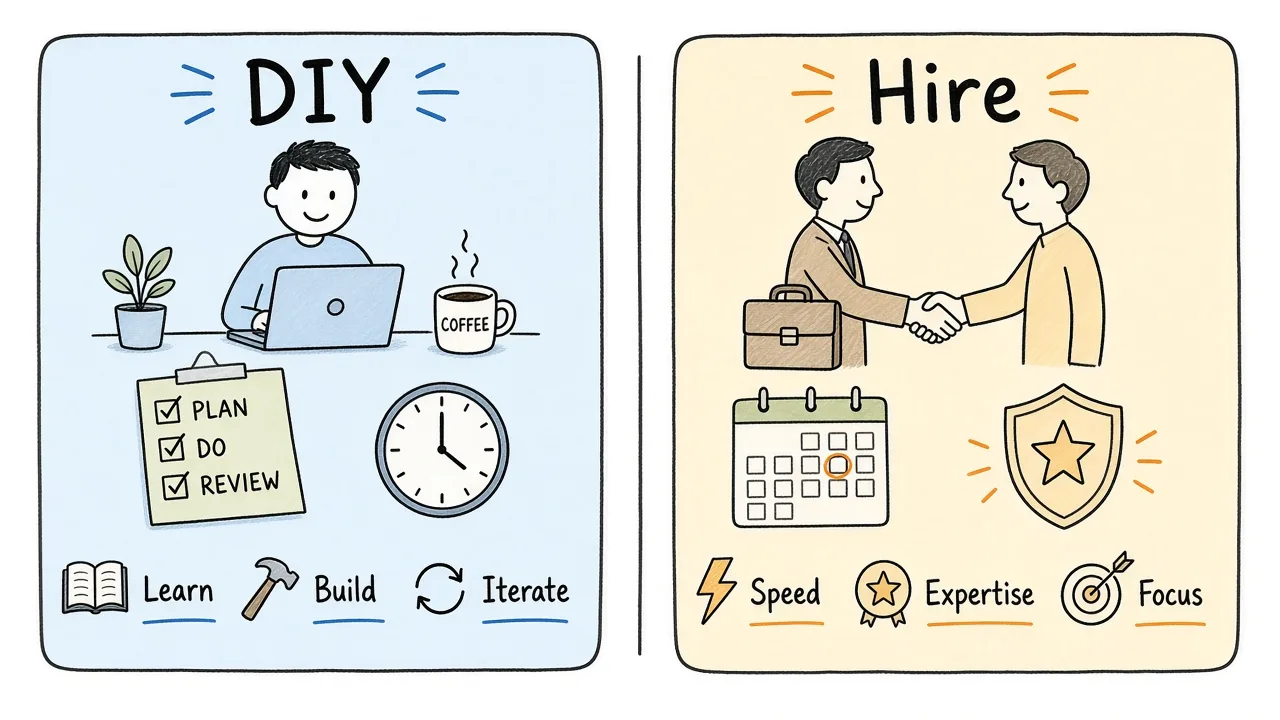
DIY ownership on one side, hire triggers on the other, with shared outputs like owners, backlog, and instrumentation.
Frequently asked questions
Is growth marketing the same as demand generation?
They overlap. Demand gen often focuses on campaigns and pipeline creation. Growth marketing on a SaaS product site also owns the connection between those campaigns, the pages people land on, the product signals that prove value, and the experiment loop that improves the system. If demand gen cannot change the site or the events, growth work is incomplete.
How many blog posts should a SaaS site publish per month?
There is no universal number. Publish at the pace you can research, ship with a product path, and maintain. One strong hub page that ranks and converts usually beats a month of thin posts. Set capacity after ICP and IA are clear.
Should we go PLG or sales-led on the marketing site?
Match the site to how you actually sell and activate. Many teams need both paths with clear routing: trial for the self-serve ICP, demo for high-seat or security-heavy deals. Forcing one motion on every page confuses both audiences.
What should we measure first if analytics are a mess?
Define ICP site jobs, pick a north-star business metric you already trust (activated trial, qualified demo), instrument the five to eight events that lead there, and rebuild one decision dashboard. Clean historical vanity later. Decisions need a thin reliable layer more than a perfect warehouse on day one.
When do we add paid search?
After at least one organic or direct path converts the ICP you intend to buy, with events you trust and a landing page that matches the query. Paid then scales a working path. It rarely invents product-market clarity.
How does this relate to product marketing?
Product marketing decides what you say and to whom. Growth marketing decides how people find you, move through the site, and return through product-led loops. Messaging first is usually cheaper, because acquisition spend on unclear messaging fails twice.
What to do next
Draw the four loops on one page for your product site, map each money URL to an ICP job and CTA, thin your events to decision questions, and run one week of experiments on the highest-friction path before you expand the content calendar. If you want help connecting SEO, analytics, conversion, and product-led surfaces into a single operating rhythm, reach out via the contact form and we can scope a focused growth engagement around the pages you can actually change.